

Categories
Community News, Local DevelopmentPublished September 28, 2026
History of the Imperial Sugar Plant in Sugar Land, TX

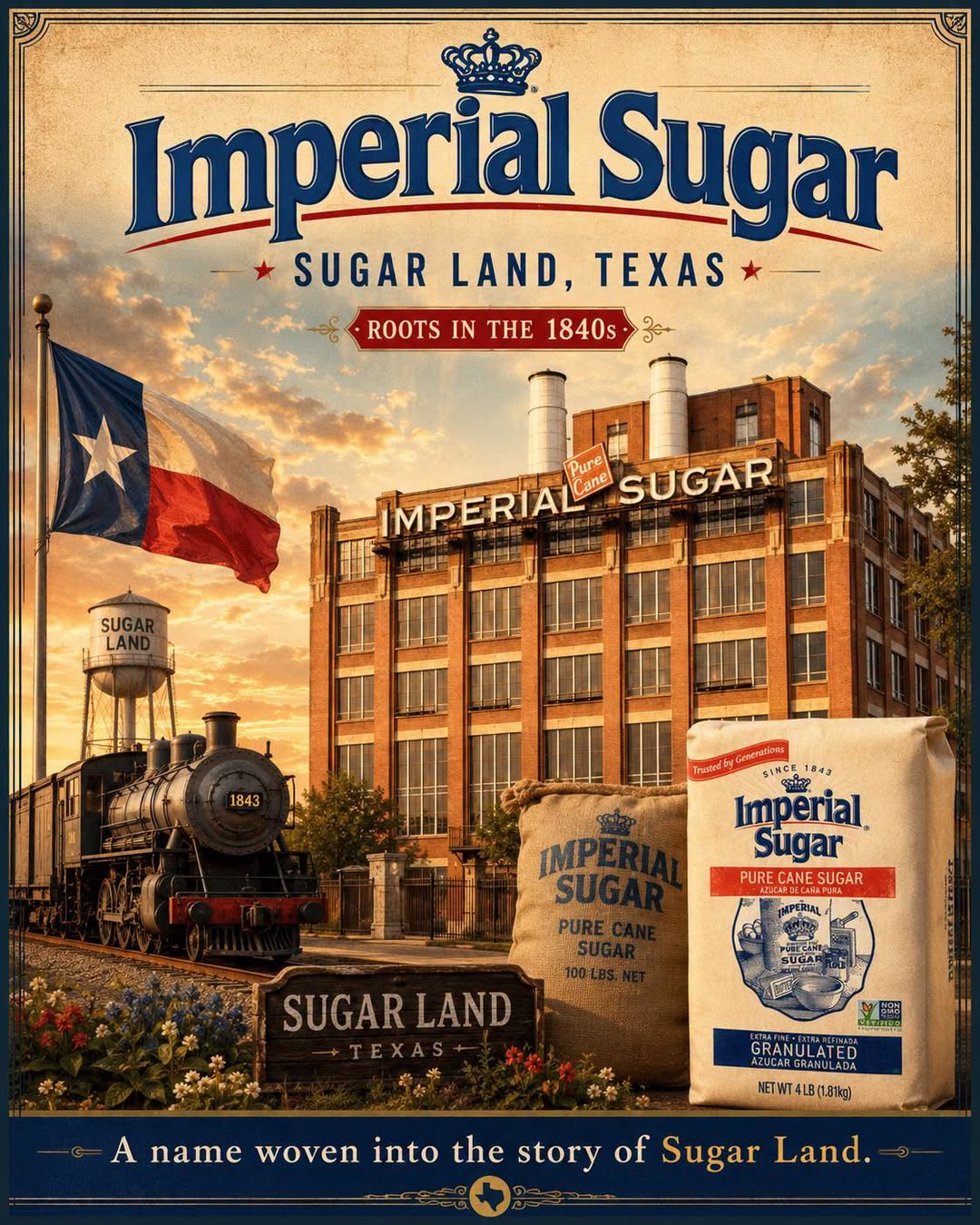
The History of the Imperial Sugar Plant in Sugar Land, Texas
If you've driven down Highway 90A through Sugar Land, you've seen it: the tall red brick Char House and the Imperial Sugar water tower rising over the old refinery grounds. These landmarks are more than a skyline. They're the reason Sugar Land exists and the reason it carries its sweet name. Here's the story of the Imperial Sugar plant, from its plantation beginnings to the redevelopment taking shape today.
Plantation Roots on Oyster Creek
Sugar Land's sugar story began long before the Imperial name. The refinery site started as Oakland Plantation on Oyster Creek, where sugar was grown beginning in 1838. Fort Bend County's rich Brazos River bottomland made it part of what became known as the Texas Sugar Bowl.
In the late 1800s, San Antonio businessman E. H. Cunningham acquired more than 12,000 acres in the area. He invested over $1 million in a sugar refinery, a new raw-sugar mill, a paper mill, and the 14-mile Sugar Land Railroad.
A Painful Chapter: Convict Leasing
Any honest history of Sugar Land includes the convict leasing system. After the Civil War, Texas leased prisoners to private businesses. The state ran this program from the late 1870s to the early 1910s, and most of the people leased out were African American. From 1877 to 1883, Cunningham and fellow grower L. A. Ellis leased and managed the entire Texas prison population to supply labor for their fields.
Conditions were brutal. Convicts worked the wet cane fields, and many died in fever epidemics. They called Sugar Land the "Hell hole on the Brazos."
That history came back into view in 2018. Workers building a Fort Bend ISD career and technical education center began finding remains that February. By summer, 95 people had been recovered from unmarked graves. Researchers believe the graves date to between 1878 and 1910, when Texas formally ended the program. Today these individuals are remembered as the "Sugar Land 95." Their discovery has become an important part of how the community understands its past.
Kempner, Eldridge, and the Birth of Imperial Sugar
By 1902, Cunningham's health was failing, his plantations, mill, and refinery were deteriorating, and his company went into receivership. Between 1906 and 1908, Isaac H. Kempner of Galveston and William T. Eldridge of Eagle Lake bought the Ellis and Cunningham plantations and the Cunningham Sugar Company. They modernized the operation and turned the community into a company town.
The new owners named the business Imperial Sugar Company. Kempner linked the name to the Imperial Hotel in New York, and it was also the name of a small raw-sugar mill on the Ellis Plantation.
Building a Company Town
Under the Kempner-Eldridge agreement, Eldridge moved to Sugar Land to serve as general manager and build the company town. The partners owned every piece of land and every business in town. Many of the families who moved there were German and Czech immigrants.
Imperial built much of the town's early infrastructure. In 1913, it constructed 8 miles of levee and 20 miles of drainage ditches to protect Sugar Land from Brazos River flooding. In 1918, it built Lakeview Elementary School to attract good workers. The company also branched out beyond sugar into meatpacking, canning, and making vinegar and pickles.
The Char House and the Water Tower
In the early 1920s, Kempner and Eldridge faced new competition from other Texas refineries, so they set out to increase refined sugar output by 50%. They replaced the old building that held the bone char filters with a new eight-story steel and brick structure right on Highway 90A.
Inside, the Char House held 30 huge cast iron tanks filled with bone char. Amber sugar syrup was poured in at the top and filtered through the char, which absorbed the impurities and left the syrup clear. It was then piped to another building to become white refined sugar. The building cost $1 million to construct.
The new building's height created a problem: the existing water tower couldn't deliver enough pressure to fight a fire at the top. Imperial built a new tower 50 feet taller, which made it the tallest structure west of the Mississippi River at the time.
Surviving the Depression and War
The Great Depression hit hard. By 1932, Imperial was the last sugar producer left in Texas. During World War II, government sugar rationing contracts gave Imperial the job of supplying all the sugar for Texas and Oklahoma.
In 1946, the Kempner family bought out the Eldridge interest and became the sole owners of Sugar Land. By the 1950s, the refinery was producing more than two million pounds of sugar every day.
From Company Town to City
As Houston grew during the 1950s housing boom, Sugar Land incorporated as a city in 1959. Imperial Sugar also began selling off the land and the rental housing it had built for its workers around this time. In the 1970s, the Kempners sold most of their remaining local holdings as the city expanded.
Until 1988, the Sugar Land plant was the only mill Imperial operated. That year, the company bought the Holly Sugar Corporation of Colorado Springs. The original Sugar Land refinery shut down in 2003, although Imperial kept its corporate offices in the city.
Restoring an Icon: The Water Tower
The refinery was quiet after 2003, but its landmarks stayed part of Sugar Land's identity. In 2014, Johnson Development Corporation funded the restoration of the iconic water tower. The structure was stabilized, repainted, and topped with the Imperial Sugar Land logo, and it remains one of the city's signature sights.
The Imperial Historic District Today
For more than two decades, redevelopment of the old refinery site stalled. Earlier plans fell apart, including a $1 billion mixed-use proposal from PUMA Development that failed because of financial and market constraints.
That changed in June 2025, when the City of Sugar Land bought the 40-acre property. It was the first time the city had ever owned the site. City Council had approved up to $50 million for the purchase in February 2025.
Since then, the city has moved steadily forward:
- It held community visioning workshops in November 2025.
- It unanimously adopted a vision statement and guiding pillars for the district on February 3, 2026.
- It released a Request for Qualifications for a master development partner on February 25.
- It expects to choose that partner by the end of 2026.
- Design work to preserve the Char House is underway, and construction is expected to begin in fall 2026.
With so little undeveloped land left in Sugar Land, the district is a rare chance for large-scale redevelopment in the heart of the city.
Frequently Asked Questions
When did the Imperial Sugar refinery in Sugar Land close?
The original Sugar Land refinery stopped operating in 2003.
How did Imperial Sugar get its name?
Isaac Kempner named the company after the Imperial Hotel in New York. Imperial was also the name of a small raw-sugar mill on the Ellis Plantation.
What is the Char House in Sugar Land?
The Char House is an eight-story brick building from the 1920s. Its bone char filters turned amber sugar syrup clear before it was refined into white sugar.
Who owns the Imperial Sugar site now?
The City of Sugar Land bought the 40-acre Imperial Historic District in June 2025 and is searching for a master development partner.
What are the Sugar Land 95?
The Sugar Land 95 are the 95 people whose remains were found in 2018 at a Fort Bend ISD construction site. Researchers believe they were victims of the convict leasing system.
Live Where History Meets the Future
Sugar Land's story, from sugar cane fields to one of Houston's most sought-after suburbs, is part of what makes it such a special place to call home. As the Imperial Historic District moves into its next chapter, there's never been a more exciting time to live in Sugar Land. The Cathy Stubbs Team at Keller Williams helps clients buy, sell, build new, invest, and lease throughout Sugar Land, Richmond, Rosenberg, and Greater Houston.
Ready to talk? Call us at 281-967-6149 or visit our office at 307 Ulrich St., Sugar Land, TX 77478, just down the road from the Char House.

Cathy Stubbs
Team Leader / Owner | The Cathy Stubbs Team
or another way